Many growing businesses don’t slow down because demand disappears.
They slow down because as operations expand, managing inventory, transactions, reporting, and branch coordination becomes harder to control consistently.
Many businesses struggle to scale because everything depends on the owner.
In the early stages, most businesses rely heavily on manual tracking, coordination, and reporting.
The owner monitors inventory personally, often spending hours checking stock, verifying counts, and solving daily issues instead of focusing on growth.
Managers coordinate through non stop calls and group chats, constantly following up on updates, clarifying information, and trying to keep teams aligned across shifts and branches.
Sales and inventory reports are reviewed manually.
Operational issues are handled only after discrepancies, delays, or missing information start disrupting the day.
And for a while, that works.
But growth starts exposing operational gaps like inconsistent reporting, inventory inaccuracies, delayed visibility, and disconnected branch processes.
When Growth Starts Creating Operational Pressure
A retail business handling more SKUs and higher transaction volume begins struggling to track inventory accurately across multiple locations, leading to stock discrepancies, delayed replenishment, overstocking in some branches, and missed sales opportunities in others.
An F&B operation managing peak-hour demand starts experiencing order delays, inconsistencies, and reporting gaps between shifts, creating pressure during busy hours, slowing service, and affecting the customer experience when speed and coordination matter most.
A franchise business expanding into multiple branches realizes each location is operating differently, using different processes, different tracking methods, and different sets of data, making it harder to trust reports, compare branch performance accurately, and maintain operational consistency across the organization.
What once felt manageable starts becoming harder to monitor consistently as transaction volume, inventory movement, staff coordination, and reporting requirements increase daily.
Why Hiring More People Doesn’t Always Solve the Problem
This is the stage where many businesses assume they simply need more staff.
So they hire more people.
But when teams rely on disconnected systems, adding more people often creates even more follow-ups, duplicated updates, repeated report checking, and manual coordination — increasing operational noise instead of improving control.
More manual encoding.
More follow-ups.
More checking and reconciling of reports.
More room for human error.
The real issue is often the lack of a clear, real-time view of what is happening across the business — making it harder to identify inventory issues early, monitor branch performance consistently, respond to sales slowdowns quickly, and resolve operational problems before they affect revenue.
When owners cannot clearly see sales performance, inventory movement, branch activity, and operational trends as they happen, decision-making becomes reactive.
Problems are addressed only after revenue is already affected.
Why Modern POS Systems Matter for Growing Businesses
This is why modern POS systems are no longer limited to processing transactions at the counter.
For growing businesses, they help centralize reporting, improve inventory and sales visibility, standardize branch oversight, and reduce the daily coordination pressure that comes with managing multiple teams, transactions, and locations.
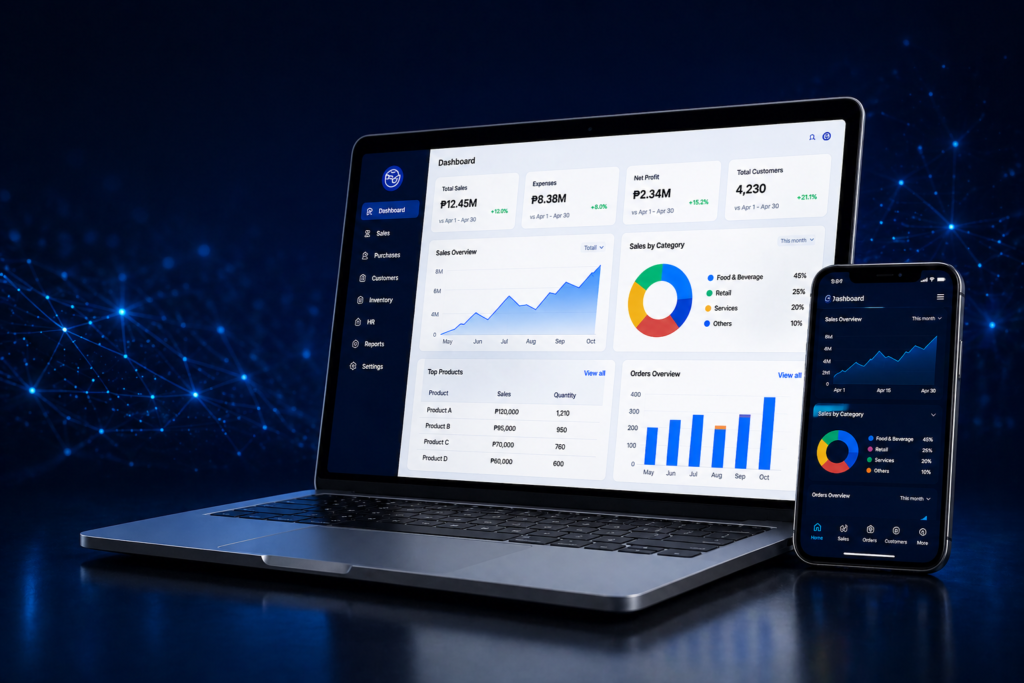
The right POS system helps simplify transaction monitoring, inventory tracking, reporting, and branch oversight while giving owners and managers a clearer understanding of what is happening across the business in real time.
Automation creates systems.
Systems create freedom.
Instead of relying on delayed reports, businesses gain real-time visibility that supports faster decisions around inventory replenishment, staffing, purchasing, and branch performance.
Instead of manually consolidating data from different stores or teams, operations become easier to monitor across locations with more consistent reporting and fewer follow-ups.
Instead of reacting late to inventory shortages, teams can identify fast-moving products earlier, improve replenishment planning, and reduce avoidable stock issues before they start affecting sales.
How Better Operational Visibility Supports Sustainable Growth
For retail businesses, this means tighter inventory control and better visibility into product movement.
For food and beverage businesses, this means smoother high-volume operations, fewer order inconsistencies, and more reliable customer experiences during busy periods.
For multi-branch businesses, this means more consistent reporting, clearer oversight across locations, and better operational alignment as the business continues to grow.
The businesses that scale successfully are rarely the ones relying on constant heroic effort.
They are the ones building clearer reporting processes, better inventory visibility, and more consistent operational workflows before complexity starts slowing the business down.
Because sustainable growth is not just about selling more.
It’s about building operations that teams can manage confidently, leaders can oversee clearly, and businesses can scale with better visibility, stronger coordination, and fewer operational surprises along the way.
Ready to Improve Operational Visibility Across Your Business?
Growing operations shouldn’t feel stressful and harder to manage.
Your business should run with systems:
- Mobile dashboard
- Notifications
- Automated Reports
Systems that improve inventory visibility, simplify reporting, reduce manual work, and support more efficient day-to-day operations as you grow.
Talk to our team to learn how the right POS system can help you build scalable operations today.